Monday, January 19, 2015

48. Paeoniaceae


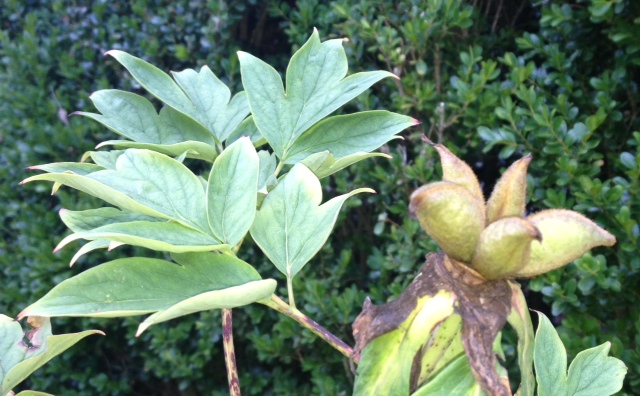
I'll always remember my Mom pointing out the Tree Peonies (above and below). A Tree Peony is any member of the genus Paeonia with a woody stem. Most are perennials. Paeonia is the only genus in the family Paeoniaceae. Some come from Asia, others from the Mediterranean and western North America. Many of the ornamental species come from China.

Monday, October 27, 2014

47. Oleaceae

The star of the Oleaceae family is of course the olive -- Olea europaea -- one of the oldest crops of Mediterranean civilization. They were brought to California in the 18th century by the Spanish padres, as this sign at Mission San Antonio explains. This beautiful specimen is thought to have been planted "about 1836". There are many, many varieties of olives and this one, curiously, cannot not be matched with any present day European variety.
An interesting member of this family that I encountered in California is Ligustrum lucidum -- also known as tree privet or glossy privet. My first impression was that it was some sort of Ficus, with glossy leaves and bony, reptilian bark. It also has white flowers in dense clusters that become dark blue, bird-friendly berries. When I think of privet, I think of the hedges I grew up around back east -- Ligustrum vulgare, which comes from Europe. Ligustrum lucidum on the other hand comes from Asia, and has spread itself fast enough to be considered invasive. And while the two plants seem very different, they are in fact both privet.

Also in the olive family is the familiar lilac -- Syringa vulgaris -- seen below. These famous ornamental plants have stalked me on both coasts.

Monday, October 13, 2014

46. Nyctaginaceae

This family, the Nyctaginaceae, takes me back to a particular period of my life when I lived in a little house that came with a little landscaping. Included in that landscaping was a bougainvillea growing on the side of the house in a flower bed that was also full of four o'clock flowers. Both plants belong to this family.

Bougainvillea is a genus from tropical America, named after the explorer Bougainville, who circumnavigated the globe with the botanist Commerson, who did the naming. What I will always remember about this plant is that, more than any other in memory, it benefited from my adding coffee grounds to the soil. Evidently the pH was off and the coffee grounds increased the soil's acidity enough to meet the bougainvillea's needs.

Four o'clock flower --  Mirabilis jalapa  -- also comes from tropical America. It has an overall pleasing structure that is very similar to tobacco plants. Are they related? According to Davis Wiki  yes, because the Nyctaginaceae IS the tobacco family. Whereas according to Wikipedia the Nicotiana genus, from which all tobacco comes, is part of the Solanaceae family. I need someone to clear this up for me, because further research is thus far getting me nowhere.

Four o'clock flowers get their name from the behavior of opening in the late afternoon and closing by morning. They self-propagate easily by spreading an abundance of seeds. Not only do the trumpet-shaped flowers come in different colors, but some varieties have multiple colors, and some even change colors over the course of their lifetime.

Sunday, October 5, 2014

45. Myrtaceae

I will always associate this family -- sometimes called the myrtle family -- with Australia, where so many of its species come from. While I have never been 'down under', many of its plants have thankfully graced the shores of California, giving those of us stateside a chance to enjoy their quirky beauty. Above all, towering eucalyptus trees (above) make an unforgettable impression, for their height (among the world's tallest), their shagginess (witness the shedding bark), and their nasal passage-clearing fragrance, especially after a good rain. Among the prevalent species are blue gum (Eucalyptus globulus), silver dollar (Eucalyptus polyanthemos), and red ironbark (Eucalyptus sideroxylon).
Above and below: bottlebrushes (Callistemon) at the entrance of San Lorenzo Park in King City, where I was first introduced to them. The name is self-explanatory.
Below, one of the red flowering gum trees (Corymbia ficifolia) of Pacific Grove that I had pondered for years before learning exactly what they were. A striking tree, both up close and from a distance.
Other unforgettable species are the cajeput tree (Melaleuca quinquenervia) -- striking for its thick, spongy bark resembling reams of slightly crumpled paper -- and the pineapple guava (Feijoas sellowiana), a widespread ornamental shrub related to common guava (Psidium guajava).

Monday, September 15, 2014

44. Musaceae

There is one word that sums up the Musaceae family: bananas.

The banana story is an interesting one and there are several good books on it, including "Banana" by Dan Koeppel and "Bananas" by Peter Chapman. For years a member of my family did work connected to the banana industry, and so I consider this topic close to home.  In addition to loving bananas themselves, I have always been strongly biased toward anything banana flavored. Above all, I consider banana yogurt to be among the greatest achievements of human civilization.  

The familiar banana traces its origins to south Asia, where two species -- Musa acuminata and Musa balbisiana -- are considered its ancestors. Decades of cross breeding and cultivation resulted in several top-selling cultivars: the "Gros Michel", the "Grand Nain" and the "Dwarf Cavendish". Resistance to various devastating diseases has been the central challenge to the development of commercial bananas.

The global banana industry is one of the giants of agribusiness and its impact on the economies of the developing world has been beyond enormous. Nevertheless, there are lesser known species and cultivars, such as pink bananas -- Musa velutina -- that are still used in the cooking of the developing world, particularly in south Asia. Other species, such as Musa basjoo, are inedible -- to humans at any rate -- but cultivated as ornamentals and for their fibers.

Plantains are varieties of the Musa genus that are starchy and better suited for cooking than eating raw. The only other genus in the Musaceae family is Ensete, which includes the false or Ethiopian banana -- Ensete ventricosum -- which is an important food source in that part of the world.

Saturday, September 13, 2014

43. Moraceae

The Moraceae or fig family includes some of the widest trees on earth. Seen here is the famously huge Moreton Bay fig tree (Ficus macrophylla) in Santa Barbara, CA. It is the largest such specimen of the Australian tree in the United States, with a width of nearly 200 feet. It was planted in 1876. Legend has it that the tree is such a well established landmark that homeless people living under its canopy have received mail there.
Anyone who thinks I do not have a fondness for Ficus doesn't know me. I pity the fool that doesn't realize that Ficus elastica is the house plant I've had more success raising, reproducing and reviving than any other. Yes, reviving. I once cut a sickly rubber plant down to the soil and left it fallow while I tried to decide what to use the planter for. Before I could make up my mind, tiny shoots sprung out of the soil and the Ficus elastica was back. The truth is, it is almost impossible to kill them.

This quality of eternal life is appropriate since it was another member of the Moraceae family, Ficus religiosa, that Buddha sat beneath and achieved enlightenment. Not surprisingly these trees, also known as Bodhi trees, are held in high esteem by Buddhists and typically planted at their monastaries. The leaves are unforgettably heart-shaped.

The religious connection does not stop there. According to the book of Genesis, fig leaves served as the first ever articles of clothing. Looking at the leaves of a common fig (Ficus carica), it is easy to see why those leaves were a good choice. Biblical botany is in itself fascinating -- who would have guessed that ingesting the fruit of a member of the Rosaceae family would result in the need to cover one's self with the leaves of a member of the Moraceae family?

Whatever the underlying reasons, plants from this family are very visually interesting. I will never forget the impression Florida strangler figs (Ficus aurea) made on me in the Everglades. The fact that they literally strangle other trees is also remarkable. Even the common mulberry trees I see in California (Morus) have a strikingly subtle sense of symmetry. Other notable members are the banyan (Ficus benghalis), breadfruit (Artocarpus altilis) -- the tropical staple of Captain Bligh fame, and Osage orange (Maclura pomifera).

Friday, September 5, 2014

42. Meliaceae

The star of this relatively small, mostly tropical family is the mahogany tree, prized for its wood. There are several African species belonging to the Khaya genus, but probably the best known is West Indies mahogany -- Swietenia mahogoni. The wood, used mainly for making furniture and musical instruments, was a major commodity of the New World colonial era. The first documented use of it was for a cross in Santo Domingo's old cathedral in 1514. The Spanish called mahogany caoba; the French, acajou. With exploding worldwide demand, the dominant commercial species switched to Honduran mahogany -- Swietenia macrophylla -- by the mid-20th century.

Another important species is the neem tree from India -- Azadirachta indica. The oil derived from its fruit and seeds is one of the most effective natural pesticides. There are many other uses -- some medicinal, some industrial, some cosmetic. The tree has long been commercially and culturally significant in India as well as neighboring Pakistan, Bangladesh, Nepal and Sri Lanka.

I can't say I've had a lot of direct experience of any of these trees. One member of the Meliaceae family that I have encountered in the course of my work is chinaberry -- Melia azedarach. Also from Asia, this one was introduced into the U.S. around 1830 as an ornamental and has spread far and wide since then.