Also known as the "plane tree" family, Platanaceae includes some of the most common street trees in the world. American representatives of this one-genus family are called sycamores, two of which are very familiar to me. The American sycamore, Plantanus occidentalis, was just about everywhere in New York where I grew up (above). The layered bark leaves an unmistakable impression. The California sycamore, Platanus racemosa, is essentially the same tree on a much larger scale. The ones in Toro County Park (below) are the largest and most impressive I have ever encountered. Their limbs are lumbering giants, in some cases so heavy that they recline horizontally on the ground.
How many plant families are there? Pierre Magnol, the man who introduced the concept of plant families in 1689, listed 76. Listed here are 76 plant families that I have crossed paths with.
Tuesday, February 17, 2015
Monday, February 16, 2015
53. Plantaginaceae
The other species was encountered in California. Actually I don't know exactly what species it was, only that it belonged to the genus Hebe, which is named for the Greek goddess of youth. Hebe is native to New Zealand and other areas in the south Pacific. The plant I encountered was an interesting looking shrub with purple flowers.
Since the Plantaginaceae family has around 1700 species it is safe to say that I have barely scratched the surface. Nevertheless, these two plants have left an indelible impression on me.
Sunday, February 15, 2015
52. Pittosporaceae
I can't say I ever heard of Pittosporum until I moved to California. Here, a number of shrubs belonging to that genus are commonly used for landscaping. Sometimes they go by the comical name "cheesewood". They are native to much of the tropical world but especially Oceania (a large area that includes Australasia).
While there are nine genera in the Pittosporaceae family, the vast majority of the species, approximately 200, belong to the Pittosporum genus. Some are identifiable by their wavy leaves (such as Pittosporum undulatum); some by their woody capsules (such as Pittosporum tobira).
I have had a meaningful encounter with one other genus, a genus that contains only one species -- Hymenosporum flavum, also known as Sweetshade in its native Australia. There, it is a common street tree, in part because it is considered a "low flammability" plant. Maybe this explains why I encountered one at a shopping center in King City, CA. It has exceptionally striking creamy-yellow flowers that have earned it its other common name, Native Frangipani (although no relation to real Frangipani).
Thursday, February 5, 2015
51. Pinaceae
The property I grew up on had rows of hemlock trees, Tsuga canadensis, on either end. These tall trees, over one hundred feet in maturity, were my earliest introduction to pines. Sometimes while reclining on the chaise longue and reading a book a hemlock needle would fall into my tea. Fortunately this is a completely different plant from Poison Hemlock, Conium maculatum, which belongs to the Apiaceae family. For me, the eastern hemlocks I grew up with embody the spirit of that place. They look majestic in any season, but perhaps especially in the snow (above).
A good west coast pine I became acquainted with is the gray pine, Pinus sabiana. While not quite as tall as eastern hemlocks, they produce enormous pine cones the size of mature pineapples (whereas, humorously, the hemlocks produce pine cones the size of small grapes). The other striking features of this tree are the color -- very muted, hence the name -- and the odd angles they grow on slopes and mountains that lend them a sort of oriental air (visible above center and scattered on slopes).
Monday, January 19, 2015
50. Phytolaccaceae
This family is sometimes known as the Pokeweed family, and it was the common weed Phytolacca americana or American Pokeweed (above and below) that I found in abundance one summer on land behind my parents' house. Although toxic, there is a hillbilly tradition of boiling the leaves three times to make a food called "poke salad". The term was made famous by Elvis Presley when he sang a cover of the song "Polk Salad Annie" in 1969.
A South American relative of pokeweed is the massive Ombu Tree (Phytolacca dioica), one of which I encountered at the Fullerton Arboretum. Evidently in countries like Argentina and Uruguay this striking shade tree is a symbol of Gaucho culture.
49. Paulowniaceae
My introduction to this mostly Asian family was a freak occurrence of Paulownia tomentosa, also known as Empress Tree, growing on my Dad's property. What distinguishes it is that it is the fastest growing tree in the world. The weed must have reached ten or twelve feet, getting our attention and making it easier to identify. Paulownia is named after the Grand Duchess Anna Pavlovna of Russia. The genus is closely associated with, and sometimes included in the Scrophulariaceae family.
48. Paeoniaceae
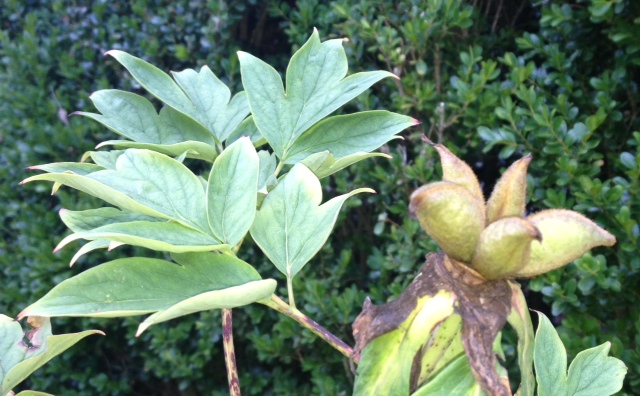
I'll always remember my Mom pointing out the Tree Peonies (above and below). A Tree Peony is any member of the genus Paeonia with a woody stem. Most are perennials. Paeonia is the only genus in the family Paeoniaceae. Some come from Asia, others from the Mediterranean and western North America. Many of the ornamental species come from China.
Subscribe to:
Posts (Atom)